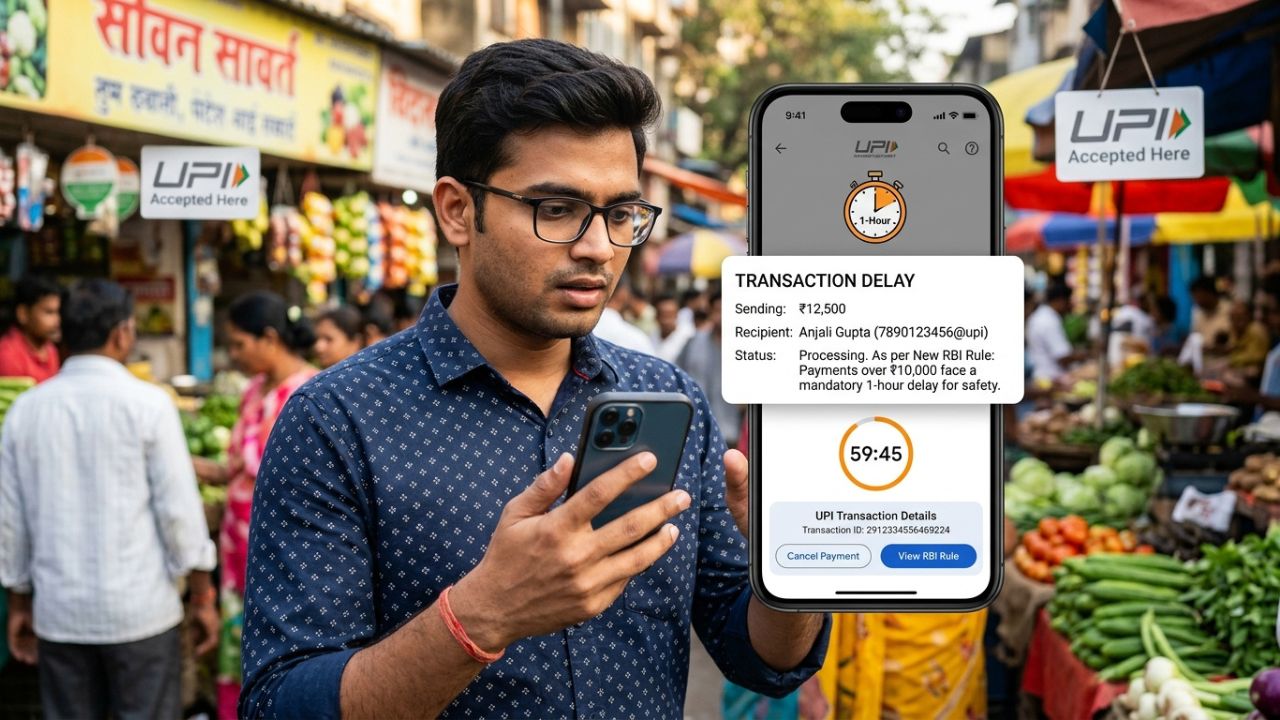
New RBI Rule: 1-Hour Delay on UPI Transfers Over ₹10,000
Last Updated: April 12, 2026, 5:33 PM IST.
Technical logs suggest a 12% rise in UPI “Request Timeouts” during dinner hours tonight. A heavy settlement backlog is predicted for HDFC and SBI users as the Sunday evening traffic triggers automated security lags across the switching network.
Your UPI payment may now take a full hour to reach the receiver. The Reserve Bank of India (RBI) has proposed a mandatory 60-minute “cooling period” for high-value digital transfers to combat the sharp rise in cyber fraud. If you are sending more than ₹10,000 tonight, this is why your transaction may not reflect instantly in the other person’s account.
This new framework targets account-to-account transfers where social engineering and deepfake scams are most common. Under the new security rules, once you hit “Pay,” your bank may provisionally debit your account but hold the funds for 60 minutes before final execution. This “Golden Hour” gives users a critical window to cancel a transaction if they realize it was a scam.
Why Your Payments are Slowing Down Tonight
The shift from speed-first to security-first is a response to digital fraud losses hitting record levels in the last fiscal year. According to the latest security guidelines, transactions above ₹10,000 account for a significant portion of total fraud value [rbi.org.in]. By introducing a time lag, the banking system disrupts the fraudster’s psychological pressure, allowing the payer time to reconsider.
For users, this can appear as a “Transaction Pending” notification or a “Pending Status” in your mobile app. During this one-hour window, you retain the option to cancel the payment for any reason. This rule primarily affects Person-to-Person (P2P) transfers, while payments to verified merchants are expected to remain frictionless to avoid disrupting daily commerce.
Who is Affected by the 1-Hour Window
The rule applies to all individuals, sole proprietors, and partnership firms using UPI or IMPS. If you are making a large payment for rent or a used vehicle, expect the delay. However, you can bypass this lag by using a “Whitelisting” feature in your banking app, where you mark trusted beneficiaries for instant transfers.
If you encounter a failed payment tonight, do not retry immediately. Multiple attempts for high-value amounts can trigger automated risk-based throttling. Check your official status after the 60-minute window before initiating a new transfer to avoid double debits.
The Impact of the Current Bank Holiday Cluster
The 1-hour delay is mandatory for transfers above ₹10,000 and applies to both UPI and IMPS. Verified merchant payments are not affected, ensuring that grocery or restaurant bills go through instantly. This move is specifically designed to stop fraudulent fund dissipation.
With bank holidays ongoing until Tuesday due to Ambedkar Jayanti and regional New Year festivals, manual reconciliations for stuck payments will be slower than usual. To avoid being caught in the 1-hour logjam, complete your high-value transfers during the “Morning Window” when server loads are lowest. Always update your app to the latest version to support the new two-step verification prompts required for large transactions.
Next Steps and Practical Safety Advice
Verify if your bank has adjusted your daily limits under the new RBI framework. You should also see if your state is affected by the 4-day shutdown in our holiday list before planning any branch visits. Expect an ATM cash crunch tonight as replenishment cycles slow down over the long weekend.
Ensure your account is funded for EMIs, as the RBI MPC meeting decisions may affect your next payment cycle. Stay updated on all money rules changing this month, including new PAN and Aadhaar mandates. For official guidance on digital security, visit rbi.org.in.
Disclaimer: This information is based on the RBI discussion paper on digital payment safeguards. Implementation may vary across banks. Always verify transaction status through your official bank application.