


Live Updated: April 8, 2026, 5:10 PM IST
The RBI held its repo rate steady at 5.25 percent today, but the real question now is June. The next MPC meeting is set for June 3-5, 2026, and whether your home loan EMI rises or stays flat will be decided there.
Today’s hold was widely expected. What most borrowers want to know is: will the RBI be forced to hike rates at its next meeting in June, or will rates stay put again? The answer depends on oil prices, inflation data, and what happens in West Asia over the coming weeks.
What the RBI Decided Today and Why It Matters for June
The Reserve Bank of India kept the repo rate unchanged at 5.25 percent in its April 8, 2026 MPC meeting, maintaining a neutral stance. RBI Governor Sanjay Malhotra announced the decision after the three-day meeting concluded.
This was the second meeting in a row where the rate was held. Governor Malhotra said recent spikes in energy prices due to conflicts pose a risk, although retail prices of petrol and diesel have remained unchanged so far.
The RBI also gave its first economic forecasts for FY27. The committee held the repo rate steady at 5.25 percent and retained a neutral policy stance. The RBI projected real GDP for FY27 at 6.9 percent. Core inflation is projected at 4.4 percent, with underlying inflationary pressures described as contained. However, risks to these projections are on the upside.
For a full breakdown of how today’s rate decision affects your SBI, HDFC, and PNB home loans right now, see our detailed coverage of the RBI repo rate April 2026 EMI impact.
When Is the Next RBI MPC Meeting?
The second bi-monthly policy review meeting is scheduled for June 3-5, 2026. This will be followed by three-day meetings in August, October, December, and February.
The decision on June 5 will be the next moment when your EMI could either go up or come down. Six meetings are scheduled for the full financial year FY2026-27, meaning the RBI gets six chances to act on rates before March 2027.
Will the RBI Hike Rates in June 2026?
Most economists say a hike is unlikely but not impossible. JP Morgan’s chief India economist Sajjid Chinoy said rising inflation risks increase confidence that the RBI will keep policy rates on hold. He added that the bar for any rate hike is very high and would require a sustained supply shock that pushes headline inflation well above target for the foreseeable future.
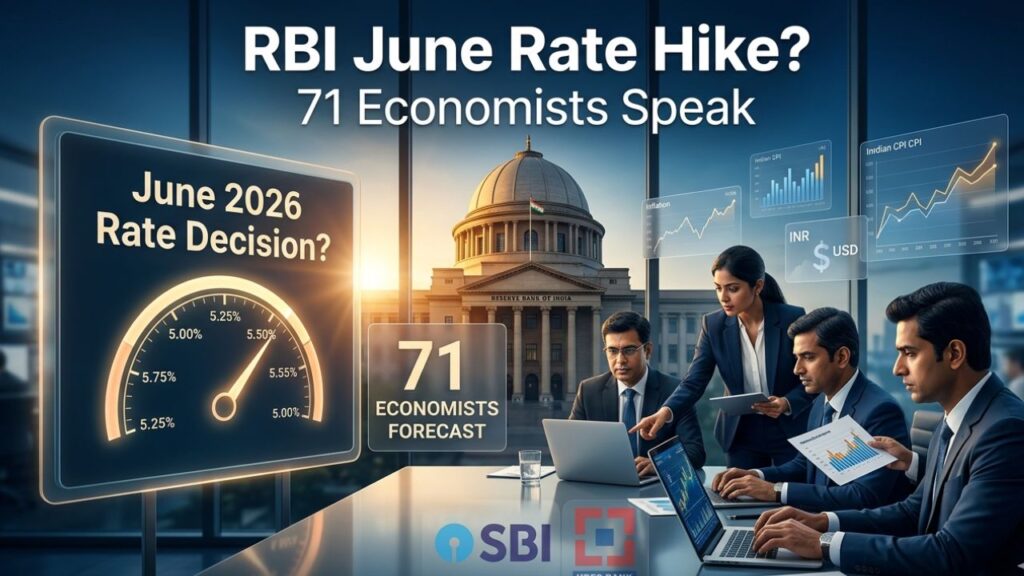
A Reuters poll conducted from March 23 to 26 showed that 69 out of 71 economists forecast the repo rate to remain steady at 5.25 percent. That is an overwhelming consensus for a hold. However, the same economists are watching two key risks.
First, crude oil above 100 dollars per barrel. Second, the Indian rupee weakening significantly. Financial markets have started pricing in a more hawkish scenario since the outbreak of the Iran conflict, with overnight indexed swap contracts increasingly factoring in the possibility of rate hikes.
Bank of Baroda’s chief economist said the impact of the war on growth and inflation will become clearer in the next 3-4 months, and the RBI is likely to then take a call on the direction of its rate trajectory. If inflation breaches the upper tolerance band of 6 percent, there could be a rate hike towards the end of the year.
HSBC pushed back on the rate hike view, saying the bar for rate hikes remains high. HSBC economists said they do not expect rate hikes over the foreseeable future as they believe the RBI will focus on one-year ahead inflation, which may look softer than inflation in the immediate months.
You can also read our earlier analysis on EMI drop predictions for April 2026 to understand how the picture has shifted since that forecast was written.
You Need to Know
The RBI held the repo rate at 5.25 percent on April 8, 2026, for the second meeting in a row. The next MPC meeting is June 3-5, 2026, and the decision will be announced on June 5. A survey of 71 economists found that 69 expect rates to stay unchanged again in June.
A rate hike is only likely if crude oil stays above 100 dollars per barrel for months and CPI inflation climbs above 6 percent. Future rate moves will remain contingent on incoming growth and inflation data, underscoring a measured and data-driven approach to monetary policy. If the West Asia conflict eases and oil prices fall, a rate cut later in FY27 remains a real possibility.
Rate comparison for home loan borrowers after today’s hold: SBI: 7.50 percent to 8.45 percent. HDFC Bank: starting at 7.90 percent. PNB: starting at 7.55 percent. Axis Bank: starting at 8.75 percent. These rates are unchanged and will only move if the RBI acts in June.
What Should You Do Before June 5?
Between now and June 5, watch two numbers closely: India’s CPI inflation reading for April (due in mid-May), and Brent crude oil prices. If April inflation comes in above 5 percent and oil stays above 100 dollars, the probability of a June hike rises. If inflation stays near 4 percent and oil prices ease, your EMI is safe for another two months.
If you have a home loan that is still linked to MCLR (marginal cost of funds-based lending rate) rather than the repo rate directly, speak to your bank about switching. Repo-linked loans pass on rate changes faster and more fairly. You can check the official monetary policy page and all past decisions directly on rbi.org.in.
For a broader picture of how financial rules are changing this year, check our guide on money rules changing from April 1 that affect your salary, taxes, and bank account.
Read Next:
- Understand how the 8th Pay Commission DA hike and April 2026 arrears will affect your salary before the June MPC meeting
- Check our Post Office Monthly Income Scheme 2026 interest rate guide if you want a fixed-return option unaffected by rate uncertainty
- Find out which bank branches are closed this month with the bank holidays April 2026 state-wise list
Disclaimer: This article is for informational purposes only and does not constitute financial advice. Interest rate forecasts are based on analyst predictions and may not reflect actual RBI decisions. Please consult a certified financial adviser before making any loan or investment decisions.